Path of Agent
Path of Agent
Desktop analysis for PoE 1
Desktop-first analysis for PoE 1

Turn imported builds into clear upgrade paths.

Path of Agent is a desktop companion for Path of Exile 1. Import your build, run a unified analysis that tests gear, skills, and passive-tree changes together inside Path of Building, and get concrete upgrade packages with stat diffs measured — not predicted.

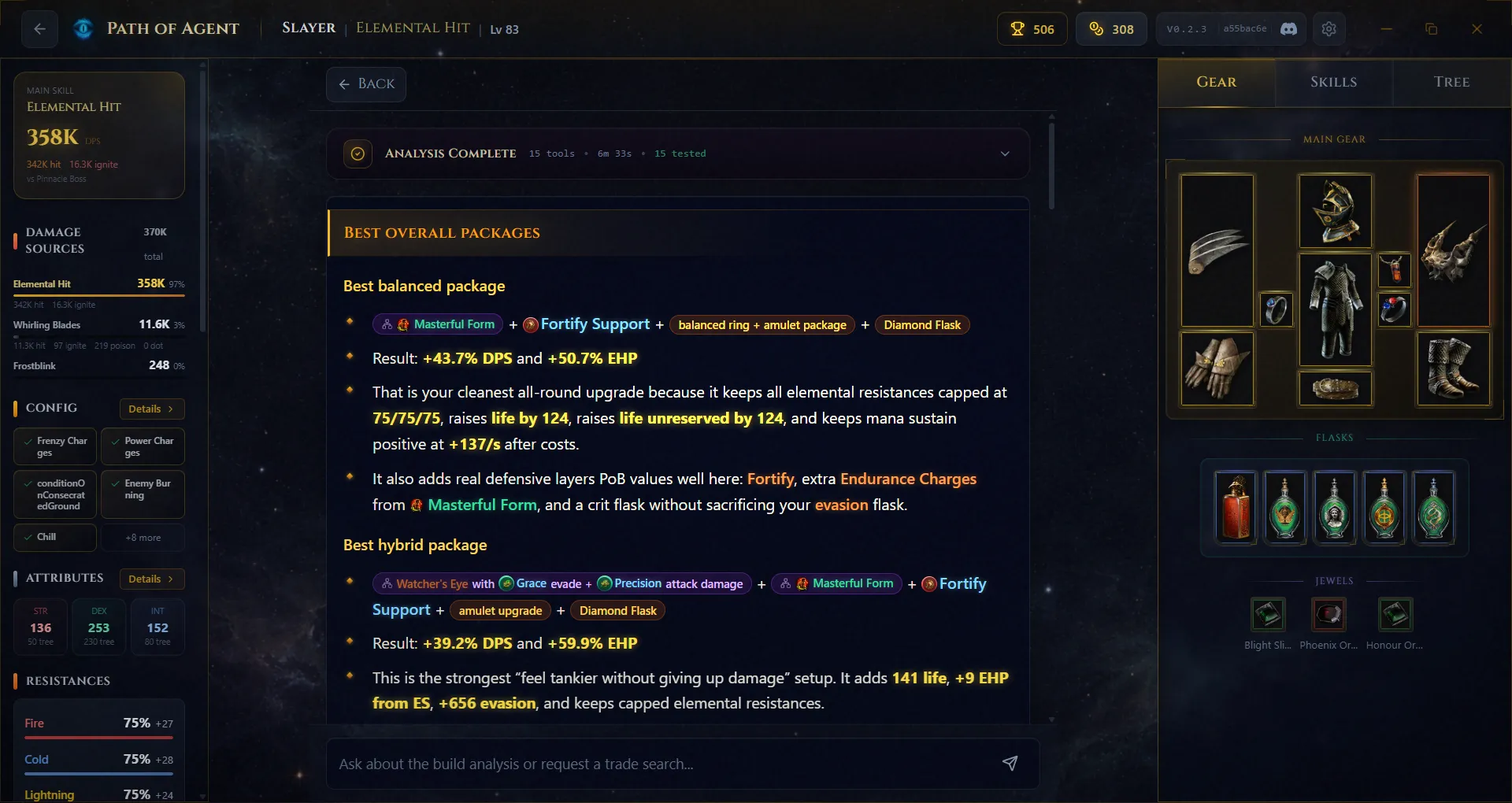
Path of Agent desktop app showing a streamed unified build analysis
View
What's in the app

Four things Path of Agent does

One core analysis engine, plus the reference material and account plumbing to make it usable.

Unified analysis

One run tests gear, skills, and tree together

A single orchestrator drives three rounds of PoB testing — individual changes first, then cross-category combinations — until the strongest upgrade packages emerge. Every stat diff comes from PoB, not the model.

Build Library · free

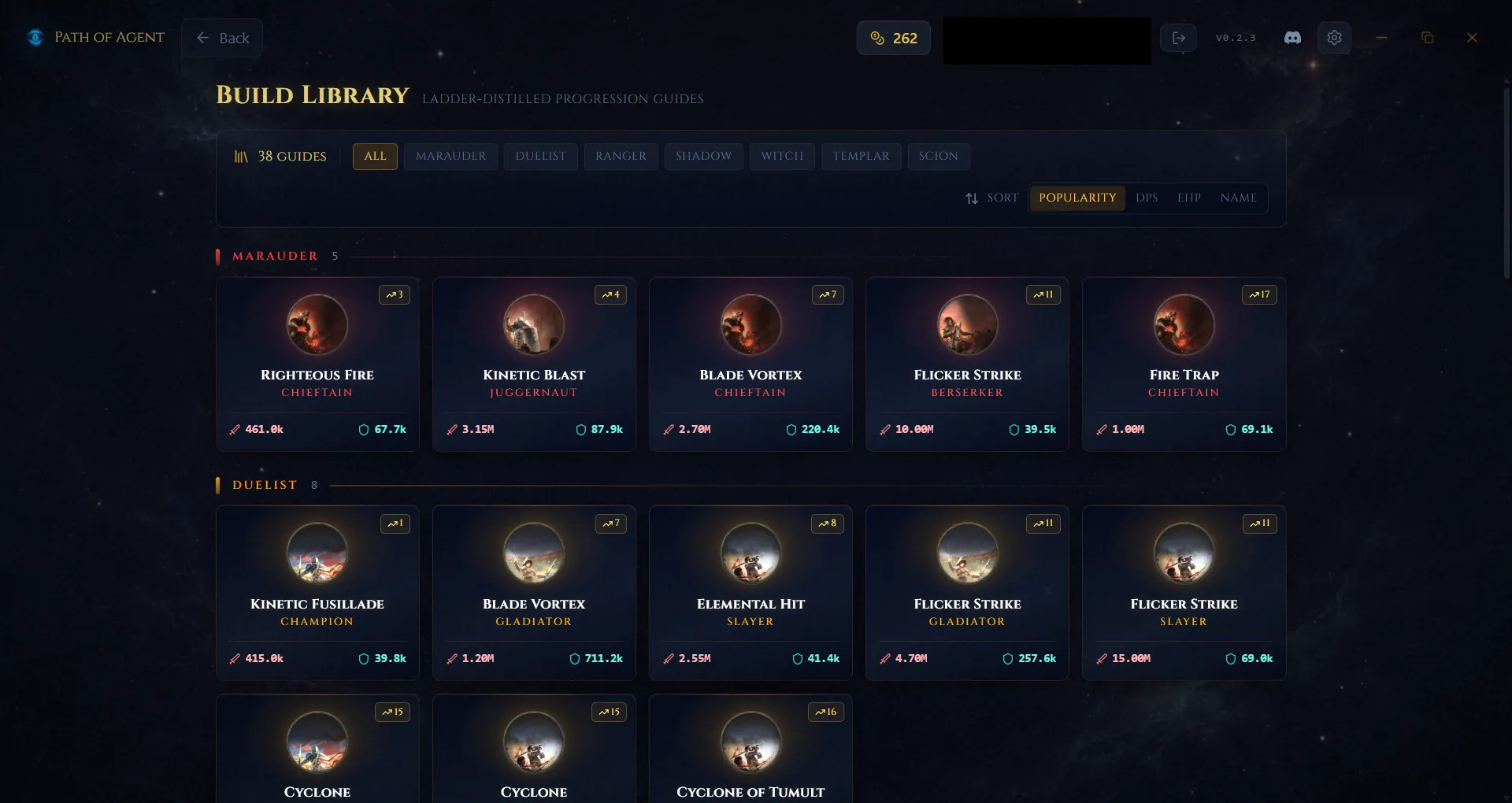
38 progression guides, no credits needed

Each guide pins near-median ladder characters at Early Mapping, Endgame, and Aspirational tiers, with full gear, gem links, and passive tree for every tier. Plus a leveling section with a scrub-through tree plan.

Ladder Benchmarks

See where your build lives on the ladder

A six-tab drawer — Overview, Skills, Gear, Tree, Configs, Progression — pulls your archetype's ladder distribution into the app. The Progression tab shows how similar builds scale from early mapping to endgame.

PoE Account sign-in

Import straight from GGG

OAuth sign-in with your Path of Exile account. Import any public character by name and the session sticks across launches. No more pasting PoB codes from pastebins.

Why test together

Changes interact — the analysis respects that

A gear upgrade needs 30 strength you don't have — the tree can pick it up. A new skill gem pushes mana cost past what you can sustain — unless the tree grabs a mana mastery to match. Testing gear, skills, and tree changes in one PoB run catches the interactions that single-slice tools miss.

Constraint detection — Catches resistance gaps, attribute shortfalls, and mana issues across combined changes

Synergy discovery — Spots where one change enables another — e.g., gear overcaps res so the tree can drop a res wheel

Verified combos — Every recommendation re-tested in PoB with real DPS and EHP numbers, not estimates

See it in action

Real analysis, not generic advice

Every recommendation is computed against your actual build using Path of Building.

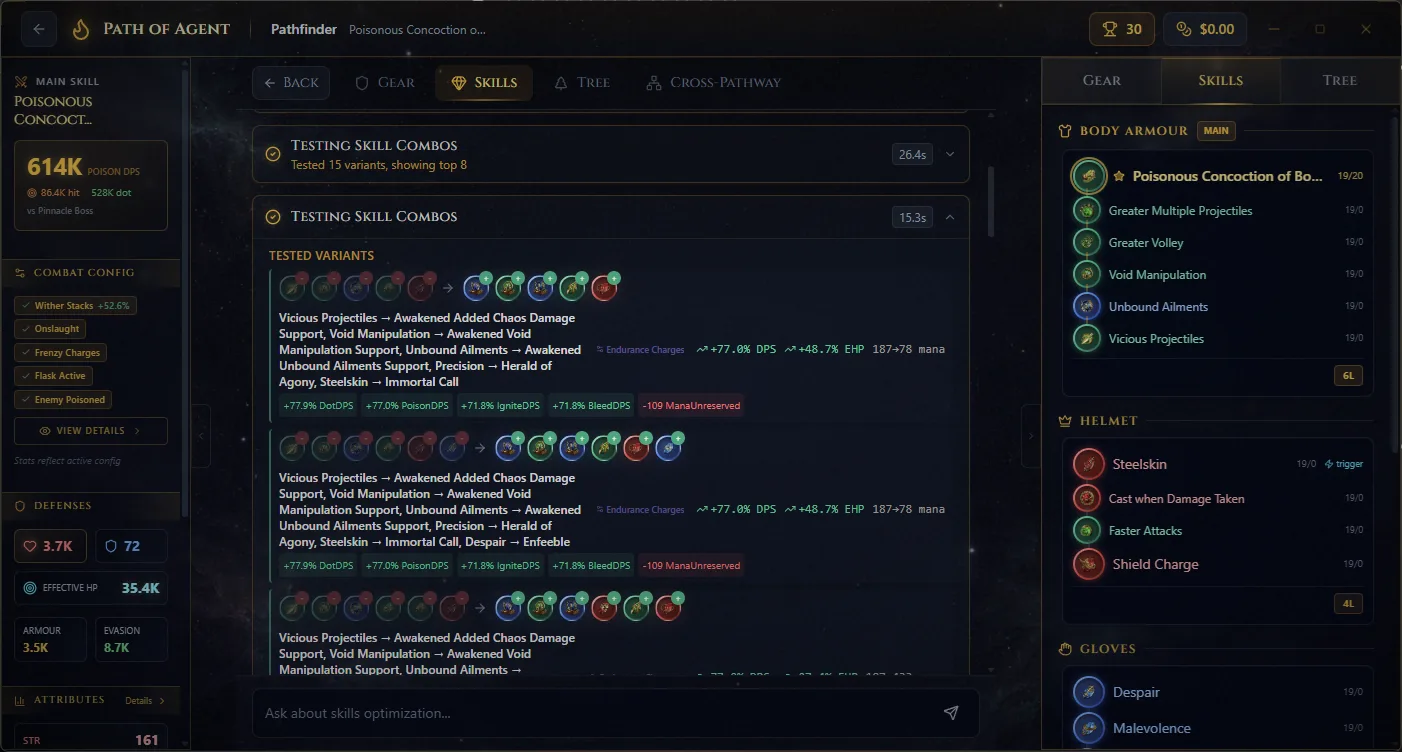
Skill analysis showing support gem comparisons and DPS impact
View
Skills slice — support gem comparisons, link optimization, DPS impact
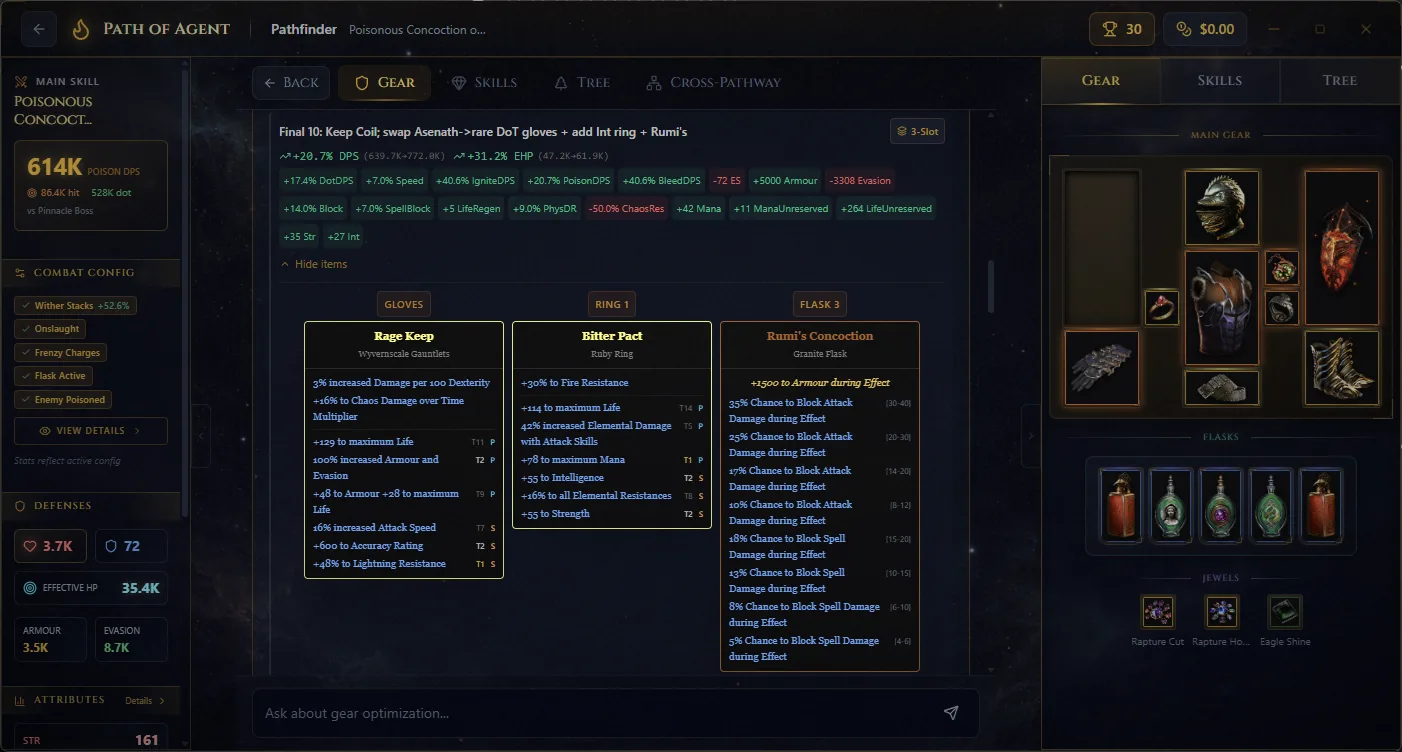
Gear analysis showing item upgrades and mod menus
View
Gear slice — slot upgrades, mod menus, PoB-verified stat diffs
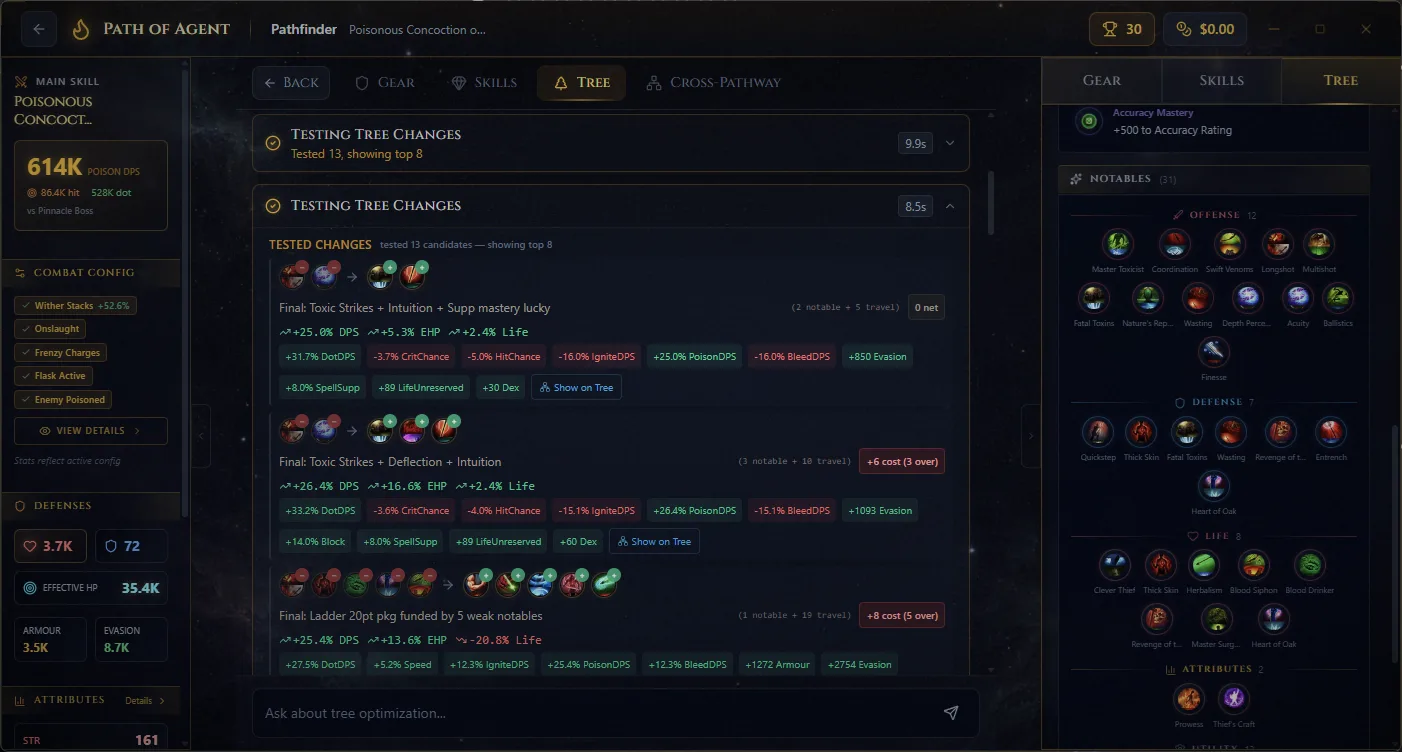
Tree analysis showing notable clusters and stat diffs
View
Tree slice — notable clusters, passive efficiency, stat diffs
The analysis pipeline

What happens when you hit Analyze

For those who want to know what's actually going on behind the streamed results.

Agent-driven, not template-based

Path of Agent imports your build into Path of Building and lets an AI agent manipulate it directly — swapping gems, equipping items, reallocating passives — measuring the actual impact on DPS, defenses, and sustain before recommending anything.

1

Preflight — state extract, ladder pull, batch test

Reads your full PoB state, detects your build archetype, and pulls ladder data for players running the same skill + ascendancy. Then batch-tests dozens of candidates — gem swaps, tree nodes, mod combinations — before the agent says a word.

2

Unified orchestrator — three rounds

One tool tests gear, skills, and tree together. Round one measures individual changes; rounds two and three combine the best winners across categories, refined each pass. Every combined change is re-tested in PoB.

3

Stream + follow-up

Results stream as they compute. When you want to drill further — test a different gem, price a listing, try an ascendancy swap — the follow-up chat has the same tools the analysis did.

Example: unified round

→ Extract build state + pull ladder context

Full PoB state out, archetype detected, near-median ladder characters for your skill + ascendancy loaded

→ Round 1 — test individual changes

Dozens of gear, gem, aura, curse, keystone, and notable swaps — each measured alone in PoB

→ Rounds 2–3 — combine winners across categories

Best gear + skill + tree changes layered together, re-tested, refined. Constraint checks catch res gaps and attribute shortfalls.

← Final combined packages

"Swap Spell Cascade → Controlled Destruction + grab Heart of the Warrior cluster: +18% DPS, +11k EHP. Res still capped."

Every number in the output was computed by PoB, not predicted by the model.

Under the hood

An AI agent wired into a real PoB engine

Not a chatbot guessing at your build — an agent with custom tools operating a full Path of Building simulator.

Agent + Path of Building

Custom tools, real calculations

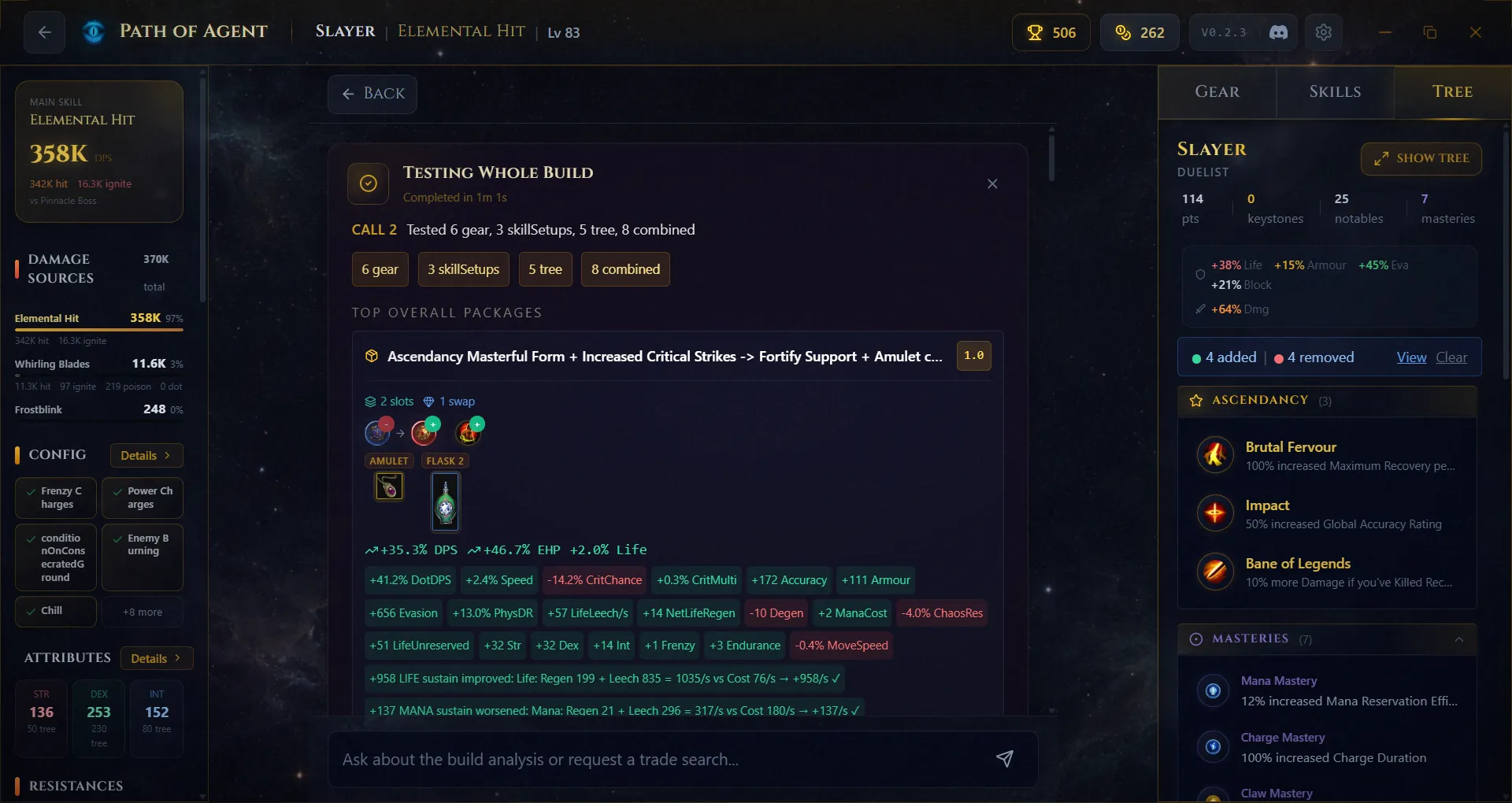
When you start an analysis, an AI agent receives your full build state and a set of custom tools wired into Path of Building. It can test gem swaps and see the real DPS change. Simulate gear upgrades with actual mod rolls. Respec tree nodes and check that your resistances still cap.

Inside one unified analysis the orchestrator runs three rounds, each driving dozens of PoB simulations while the agent holds full build context the whole way through. Every change is verified against your actual character — no estimates, no hallucinated numbers.

Agent tool calls streaming during a build analysis
View
Why credits?

This depth requires a frontier model

Each tool call triggers dozens of PoB simulations while maintaining full build context across all of them. Cheaper models lose track mid-chain, skip verification steps, or hallucinate stat values. We tested extensively — only frontier-class models can handle the multi-step reasoning this analysis demands.

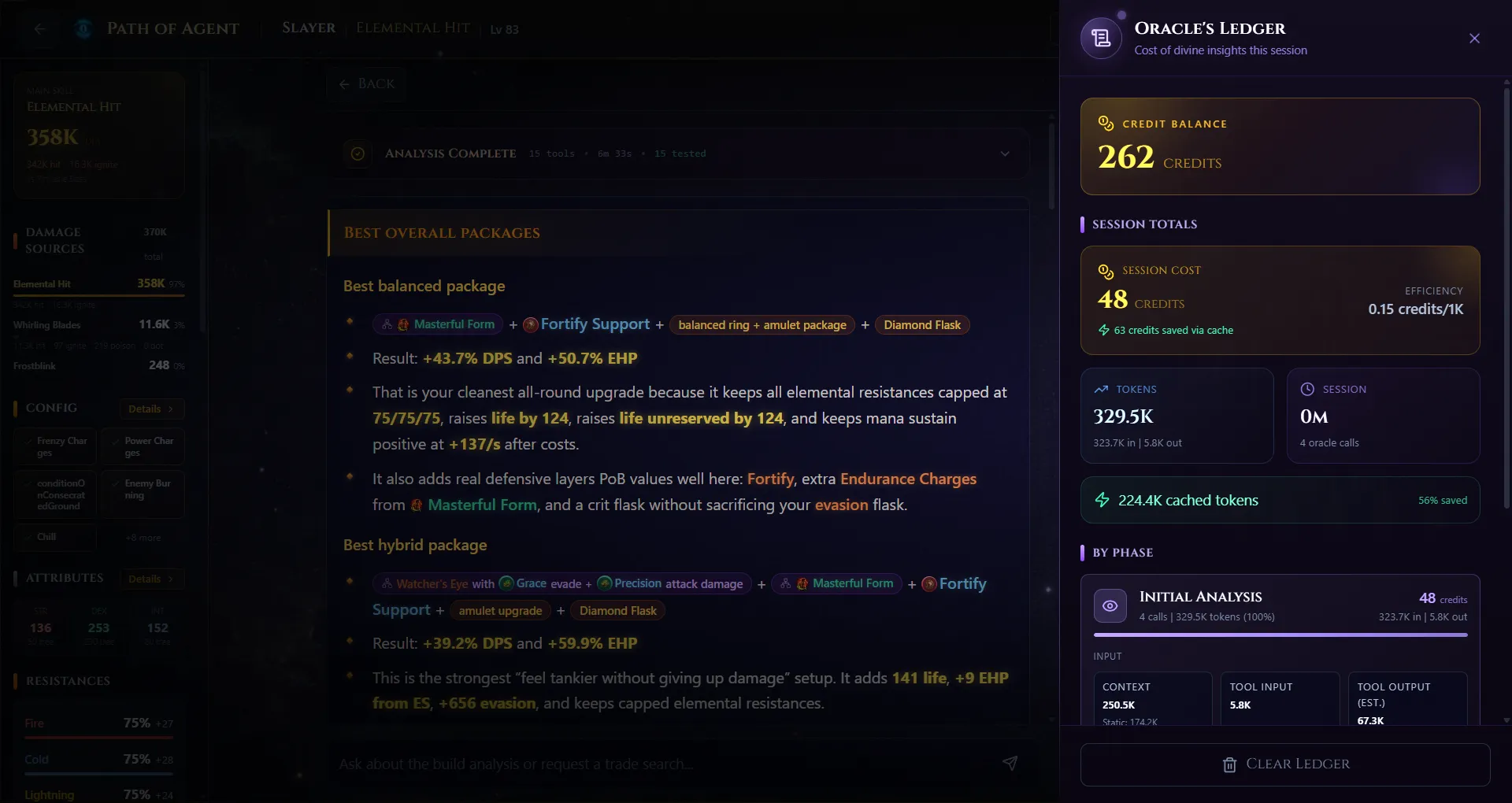
That model quality has a real cost per token. Credits let you pay for what you use — no subscriptions, no surprise charges. The Oracle's Ledger inside the app shows exactly where every credit goes.

Oracle's Ledger showing per-call credit breakdown
View
50–70
credits for a unified analysis
~10
credits per follow-up question
100 ≈ $1
credit rate (USD)

A full unified analysis runs about $0.50–0.70. Credits never expire.

100

First 100 users get 100 credits free

Create an account during the beta and verify your email — 100 free credits are granted automatically. Enough for a full in-depth unified analysis plus a follow-up or two. No credit card required.

Create free account
Questions

Frequently asked questions

What version of Path of Exile does this work with?
Path of Agent is built for Path of Exile 1 and stays in sync with Path of Building and RePoE — the two main community data sources — so game data is as current as those projects provide. Current league is Mirage (3.28). PoE 2 is not supported.
How does the analysis work?
You import a build via PoB code or public PoE Account. An AI agent receives your full build state and a set of custom tools wired directly into Path of Building. One orchestrator tool tests gear, skills, and tree changes together — every stat diff measured by the PoB engine, not predicted by the model.
What AI model does it use?
Path of Agent runs on OpenAI's GPT-5.4. The analysis chains dozens of tool calls while holding full build context across all of them — a task that demands frontier-level reasoning. We tested extensively with smaller and cheaper models, but none could handle the multi-step orchestration without losing context, skipping verification, or hallucinating stat values.
Why do I need credits?
There's no free tier because every analysis runs a frontier AI model through dozens of real PoB calculations — and that costs real money per call. Credits let you pay for what you use at your own pace. No subscriptions, no surprise charges. The Oracle's Ledger inside the app shows exactly where every credit goes.
How much does a full analysis cost?
A full unified analysis costs roughly 50–70 credits (about $0.50–0.70 USD). Follow-up questions are about 10 credits each.
Is there a free trial?
The first 100 beta users get 100 free credits — enough for a full unified analysis plus a follow-up or two. Create an account and verify your email; credits are granted automatically. The Build Library is free to browse without an account.
Is my build data shared or stored?
Your build data stays on your machine. The server only sees what's needed to run the AI analysis, and nothing is stored after the session ends.
What platforms are supported?
Windows. The app is a native desktop application built with Tauri.

Beta is live — share what you see

Screenshots, bug reports, feature ideas — the Discord is where the next features get shaped. Every report helps.